
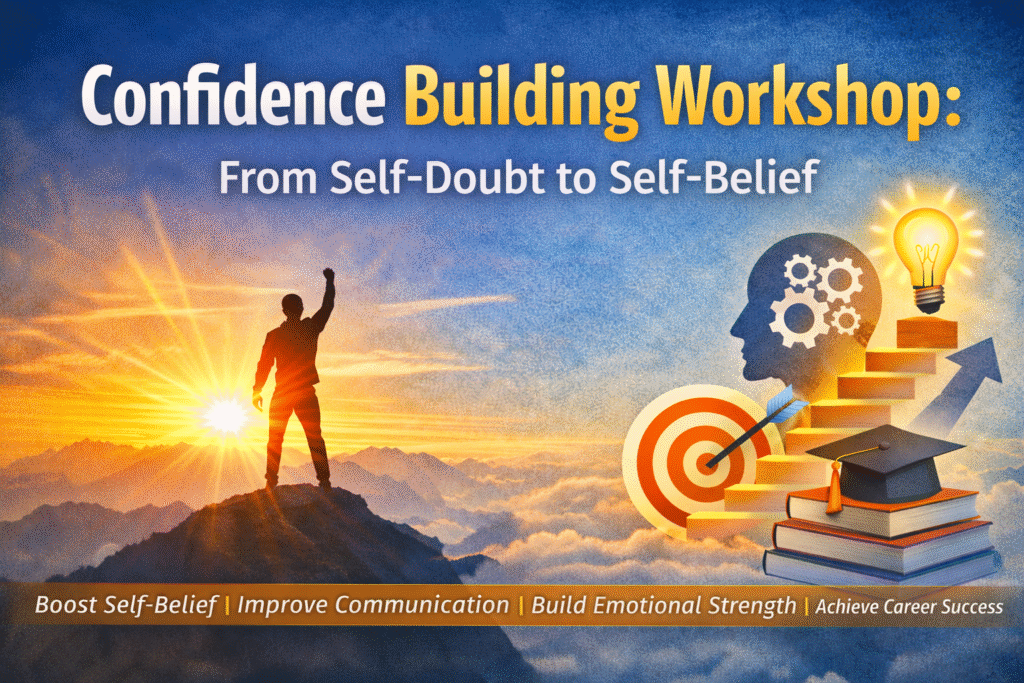
Confidence Building Workshop: From Self-Doubt to Self-Belief
Confidence is not a personality trait you are born with—it is a skill you develop.
In personal and professional life, confidence determines how you speak, act, lead, and grow.
A confidence building workshop is a powerful part of personal development because it transforms self-doubt into clarity, courage, and self-belief through structured training and practice.
This guide explains why confidence matters, what causes low confidence, how a confidence building workshop works, practical confidence exercises, and the long-term results of confidence development.
1. Why Confidence Matters ?
Confidence is the foundation of personal growth and professional success.
Confidence is the belief in your ability to think, communicate, act, and handle challenges effectively in personal and professional situations.
Why Confidence Is Essential in Personal Development
- Improves Communication Skills: Confident people express ideas clearly
- Enhances Career Growth: Confidence impacts interviews, promotions, and leadership
- Builds Emotional Strength: Confidence reduces fear and anxiety
- Improves Decision-Making: Self-belief leads to decisive action
- Strengthens Personal Presence: Confidence improves body language and influence
In personal development, confidence acts as a growth accelerator—when confidence improves, communication, leadership, and performance improve automatically.
2. Causes of Low Confidence
Low confidence does not appear overnight. It develops through experiences, habits, and mindset.
Common Causes of Low Confidence
1. Fear of Failure
Repeated fear conditions the mind to avoid challenges.
2. Negative Self-Talk
Internal criticism reduces self-belief and motivation.
3. Lack of Self-Awareness
Not recognizing strengths leads to self-doubt.
4. Poor Communication Skills
Inability to express thoughts clearly reduces confidence.
5. Past Experiences
Criticism, rejection, or comparison lowers confidence over time.
SEO-aligned insight:
Low confidence is often the result of mindset patterns, emotional blocks, and lack of personal development training.
3. Confidence Building Workshop Structure
A professional confidence building workshop follows a structured personal development framework.
A confidence building workshop combines mindset training, communication practice, emotional intelligence, and real-world exercises to build self-belief.
Typical Workshop Structure
Step 1: Self-Awareness Assessment
Participants identify:
- Confidence gaps
- Limiting beliefs
- Communication challenges
Step 2: Mindset & Belief Reframing
The workshop focuses on:
- Replacing self-doubt with growth mindset
- Building emotional intelligence
Step 3: Communication & Expression Training
Includes:
- Speaking practice
- Body language training
- Voice modulation
Step 4: Practical Confidence Exercises
Hands-on activities to apply learning.
Step 5: Feedback & Reflection
Feedback accelerates confidence development.
4. Confidence Building Exercises
Confidence grows through consistent practice, not motivation alone.
Effective Confidence Building Exercises
1. Power Posture Practice
Body language directly influences confidence.
2. Daily Speaking Practice
Short daily conversations build communication confidence.
3. Positive Self-Talk Exercises
Replacing limiting beliefs with empowering language.
4. Visualization Techniques
Visualizing success trains the mind for confidence.
5. Real-Life Role Plays
Practicing challenging scenarios improves self-belief.
Confidence building exercises strengthen self-belief through mindset training, communication practice, and behavioral repetition.
5. Long-Term Results of Confidence Building Workshops
The real value of a confidence building workshop lies in long-term personal development outcomes.
Long-Term Confidence Results
- Strong self-belief
- Improved communication skills
- Emotional resilience
- Professional presence
- Better leadership ability
- Career and personal growth
Participants experience visible transformation in:
- Body language
- Speaking clarity
- Decision-making
- Self-expression
Confidence building workshops create sustainable confidence, not temporary motivation.
Final Thoughts: Confidence Is a Trainable Skill
Confidence is not about being fearless—it is about acting despite fear.
When you invest in a confidence building workshop as part of personal development:
- Self-doubt reduces
- Self-belief strengthens
- Growth becomes natural
👉 Confidence is not given. It is built—step by step, through practice and awareness.
FAQ’s
A confidence building workshop is a personal development program that helps individuals overcome self-doubt, build self-belief, and improve communication skills through structured training and practice.
Confidence is important for personal development because it improves communication, decision-making, emotional strength, leadership ability, and overall personal growth.
Students, professionals, entrepreneurs, leaders, and anyone struggling with self-doubt or low self-confidence can benefit from a confidence building workshop.
Low confidence is commonly caused by fear of failure, negative self-talk, past criticism, lack of communication skills, and limited self-awareness.
Yes, a confidence building workshop improves self-belief by addressing mindset patterns, emotional blocks, and communication habits through practical exercises.
A confidence building workshop develops communication skills, emotional intelligence, body language, self-expression, mindset strength, and personal presence.
A confidence building workshop works through self-assessment, mindset training, communication practice, confidence exercises, and feedback for real-life application.
Confidence building starts within weeks, but strong and lasting self-confidence develops through consistent practice over several months.
Yes, confidence building workshops support career growth by improving interviews, presentations, leadership communication, and professional visibility.
Yes, confidence building workshops help overcome fear of speaking by improving clarity, posture, voice control, and emotional confidence.